What Social Grouping Best Describe Orangutan Social Life
Each evening orangutans construct a nest in the tree branches for the night in which they will curl up and sleep. These lengthy arms are essential for climbing through the rainforest.

Orangutans National Geographic
The average age of first breeding for females is around 15 years with a maximum reproductive age of 45 to 50.

. Bornean orangutans are generally more solitary than Sumatran orangutans. The social behavior of the adult animals was more subtle involving social monitoring and allogrooming. Therefore research conducted on both species helps scientists and conservation managers understand the orangutan.
They can stand up to 46 tall while their female counterparts stand about 39 tall. Activity profilesanimal interactions and. Most social bonds occur between adult females and their dependent and weaned offspring.
It is easy to see from this definition that we all belong to many types of social groups. They can range from living about 10 feet from the ground or more than 150 feet up in the trees. While orangutans lead relatively solitary lives in nature it was concluded that the opportunities for social contact and play provided by the SZG orangutan island were beneficial to this species in captivity.
The behavior of orang-utans Pongo pygmaeuswas observed in two captive groups one adult group one juvenile group. Females often live with their offspring staying in almost constant physical. Sumatran orang-utans do tend to be just slightly more social than Borneans and pairs or even small aggregations of animals are occasionally seen.
2- Groups of friends The group of friends is the second group with which a person establishes relationships. Titi monkeys owl monkeys some callitrichids marmosets and tamarins and many hylobatids gibbons and. Superficially its social organization is exceptional in comparison with that of other diurnal primates.
At first sight the orangutan may well be the least spectacular of the great apes. A fission-fusion society is one in which the social group size and composition change throughout the year with different activities and situations. These findings suggest that the.
The courtship period lasts between three to ten days and males share no role in the upbringing of their offspring. In comparison with its African cousins this solitary creature seems to lead a far less exciting life. A social group consists of two or more people who regularly interact on the basis of mutual expectations and who share a common identity.
These results indicate that orangutans at least when group-living in captivity exhibit the potential to display social behavior which is apparently of greater frequency and complexity than that which has been observed in the wild. Males grow much larger than females. Social cohesion can be formed through shared interests values representations ethnic or social background and kinship ties among other factors.
When mating the male and female orangutan stay together for only a few days. But the study is the first time that researchers have shown culturally transmitted behavior -- conduct learned from others and passed on to individuals -- among the orangutan who are less social. Opportunities for social interaction provided the animals with a means of increasing the stimulus component of their environment thus compensating for the inevitable restriction of.
Orangutan males however appear to be totally intolerant of one another especially the Borneo males who are even aggressive towards females and infants. Male orangutans participation in social groups is limited to sexual consortship with females. These nests are made out of leaves and branches.
The family group is the first group with which an individual interacts. So sticking together just that bit more means the animals are more likely to detect a hungry tiger on the prowl and. The largest group being a mother and two offspring.
Female Young Social Structure. Most orangutans in the wild live in rainforests where they enjoy the mild temperatures and plenty of food. On average orangutans spend approximately 44 of their time resting 41 feeding 13 traveling 2 nest building and less than 1 engaging in other activities such as fighting mating and socializing.
Description of the Orangutan Orangutans are large apes with big bodies and very long arms. The only long-lasting orangutan social group is the mother and offspring who live together for about 7 years. Social behavior varies between Bornean and Sumatran orangutans in that Sumatran orangutans have access to more fruit and sharing opportunities leading to greater sociability.
Orangutan Natural Habitat. Adult males occasionally wander off and forage alone or join a few other males in a hunting party. This group gives the person the essential values that will define his life.
This is the social pattern typical of chimpanzees. Orangutan activity patterns vary depending on food availability social conditions and reproductive status. This is possibly because unlike in Borneo there are tigers in Sumatra which would make a good meal of an orang-utan.
The social identity approach posits that the necessary and sufficient conditions for the formation of social groups is the awareness that an individual belongs and is recognized as a member of a group. Resident females live with their offspring in defined home ranges that. Because orangutans are primarily solitary their activity.
Our families our different friendship groups the sociology class and other courses we attend our workplaces the clubs and organizations to which we. The social structure of the orangutan can be best described as solitary but social. However the Sumatran males tend to stay with females for a longer period of time usually until the birth of the infant.
Individuals enter and leave communities from time to time. The scarcity of food means orangutans spend up to 60 of their day foraging looking for food and competition for food leads to this solitary life. Like other apes orangutans have a slow life history which makes it difficult for them to recover from severe population losses 6.
It is also in this group that the feeling of belonging for the first time develops. Notably orangutans are the only anthropoid primates with a solitary social system. Adult female orangutans at Suaq Balimbing particularly in the sub-group with greater tree-hole tool-use specialization spent more time with independent conspecifics and had more diverse.
Large males can have an armspan of up to 66 ft. They also have lots of trees in the forests for them to live in and to swing from. Oct 24 2011 1029 AM Orangutan Culture Develops Like Human Culture A team of anthropologists have shown that orangutans may have the ability to learn socially and pass these lessons down through.
Adult females are less solitary than males and have even been described as semiâsocial. They live a more solitary lifestyle than the other great apes. It is precisely this exceptional characteristic which makes the red ape an interesting test case for.
Orangutans Can Learn How To Use Stone Tools As Hammers And Knives New Scientist

Fleeting Glimpses Of Indonesia S Endangered Orangutans The New York Times
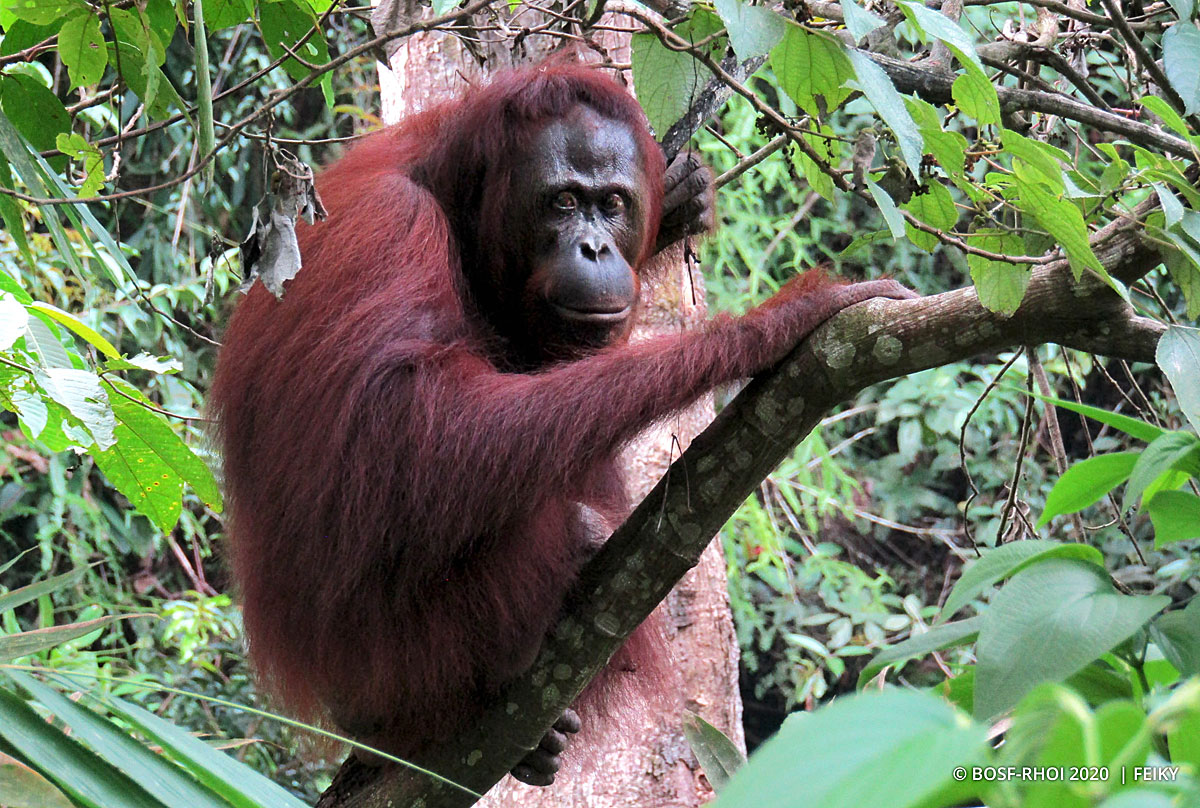
The Semi Solitary Life Of An Orangutan Orangutan Outreach


Comments
Post a Comment